How everyday routines become the child’s first great achievements
Feeding, dressing, washing, changing: care routines fill much of a young child’s day. It is easy to see them as tasks to get through quickly so we can move on to “real” activities.
Montessori saw it the other way around. For a child under three, these routines are the real activities. Each one is a chance to be an active participant rather than a passive recipient. In Montessori from the Start, Paula Polk Lillard and Lynn Lillard Jessen make a simple distinction: when we do everything for a child, we act as a servant. When we help the child do it themselves, we act as an educator.
Why it matters so much
Between roughly 12 months and 2½ years, children show an intense drive to “do it myself.” This period is often called the “terrible twos.” Montessori would call it a sensitive period for independence. The child’s energy for mastering self-care is at its peak, even though their skills are still clumsy.
If we wait until the child is “capable enough,” we often miss the moment when the desire was strongest. That is when we see three-year-olds standing still while an adult puts their coat on for them.
Independence here is not about saving the adult time. At first, it takes more time. What it gives the child is confidence that comes from real achievement, the only kind of self-esteem adults can’t hand over.
Three principles for every routine
- Break it into small steps. Tying a shoe, putting on a coat, washing hands: each is a sequence of small movements. Show one step at a time, slowly and always in the same order. Let the child take over the steps they can manage.
- Do it together: “my turn, your turn.” The child brushes, then you brush. The child pulls the sock up to the heel, then you help it over. Participation matters more than result.
- Wait. Before doing something for your child, ask yourself: Is there a step here they could do? Turn the shoe to face the right way, open it wide, and pause. Often the child surprises us.
Eating
Eating together is one of the richest moments of the day: for nutrition, for language, and for connection.
- Starting solids. The WHO recommends introducing complementary foods at around 6 months, alongside continued breastfeeding (or formula), with breastfeeding ideally continuing up to two years or beyond. Offer soft foods in a safe, appropriate size and texture. Whole grapes, whole nuts, and hard raw vegetables are choking risks for young children. Always supervise meals, with the child seated.
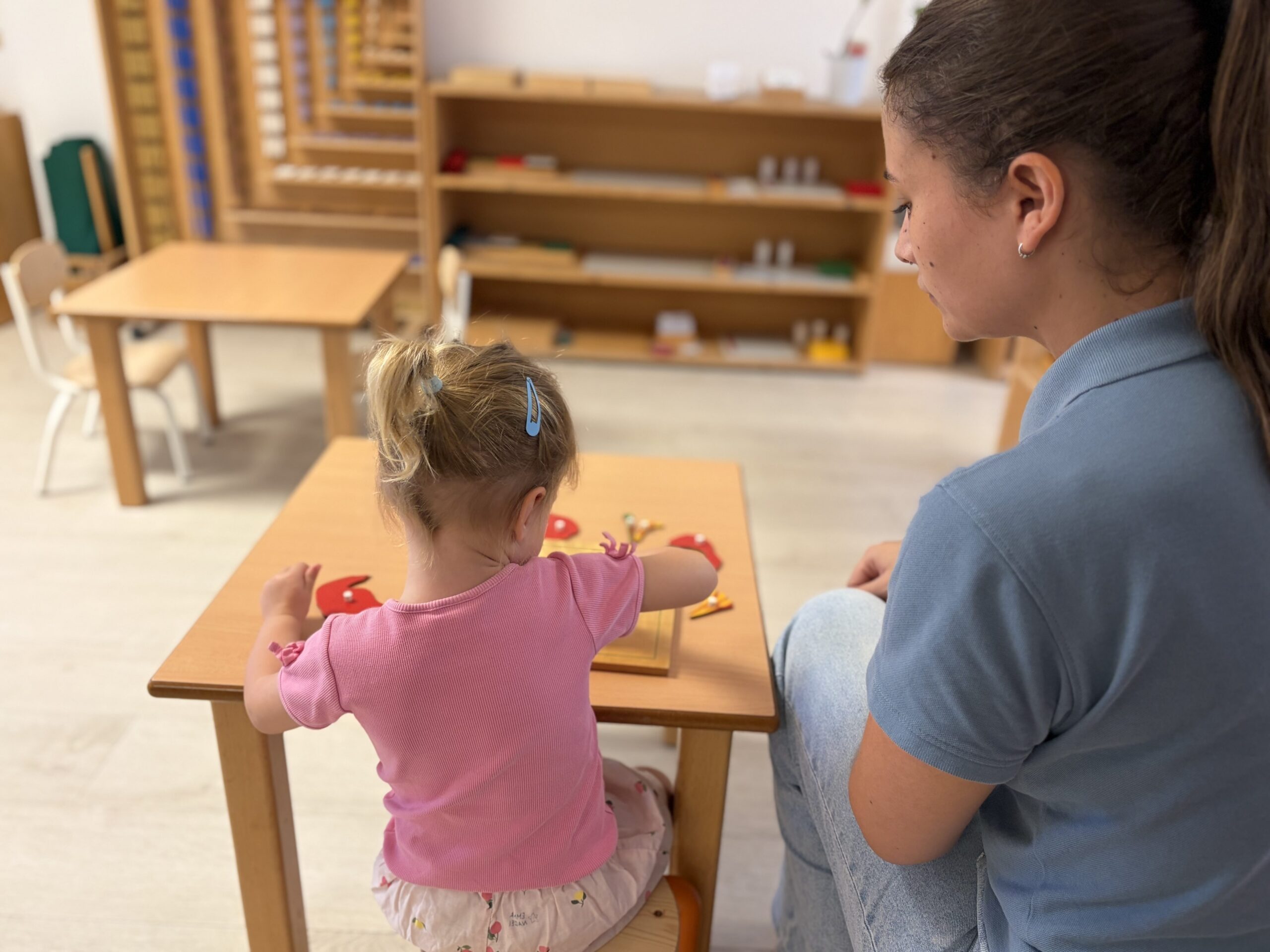
- A table at the child’s height. Montessori environments use a low weaning table and chair where the child can sit with feet flat on the floor. Unlike a high chair, a low chair lets the child eventually come and go on their own. The book describes a baby of eleven months crawling to her table and sitting down when her mother said it was time to eat.
- Real utensils, real cups. From around 6 months, offer small sips of water from an open cup. The AAP encourages introducing cups at around this age and moving away from bottles between 12 and 18 months. A small, real glass, used under close supervision, teaches careful movement in a way an unbreakable cup cannot. Let the baby hold a spoon from the start. By around 15 months, many children feed themselves with spoon and fork.
- Clear, calm limits. We eat sitting down. When a child stands up and leaves the table, the meal is finished for now. No battle, no drama. The next meal or snack will come at its usual time.
Dressing
- Choose clothes the child can manage. Elastic waists instead of buttons and zippers. Wide necklines. Shoes with Velcro or simple fastenings. Avoid tight cuffs and turtlenecks in the early years.
- Practice off the body. Lay a coat on the table and practice buttoning it there first. It is much easier than working on a button you can’t see.
- The “coat flip.” Lay the coat on the floor, lining up, collar at the child’s feet. The child puts their arms in and flips it over their head. It works for most children from around two years old.
- Limited choice. Two outfits, not a full closet. A choice of two gives the child a real decision without overwhelming them.
- A place for everything. A low hook for the coat, a basket for hats and gloves, a laundry basket for used clothes, a spot where shoes go side by side. Order in the environment helps the child build order within.
Toileting
This is the area where the original book is most firmly of its time, and where current evidence invites the most nuance.
Montessori guides observe that many children show an interest in toileting well before we expect it. Readiness signs can appear between 12 and 24 months: staying dry for longer, showing awareness of a wet or soiled diaper, following an adult to the bathroom. The AAP notes that most children are ready between 18 and 24 months, and that the process often completes between 2 and 3 years. There is wide normal variation.
What current evidence supports clearly is no pressure, no punishment, and no fixed deadline. Children whose toileting becomes a power struggle often take longer, and can develop withholding.
What the Montessori approach adds is preparation long before the “big moment”:
- Change the child in the bathroom once they are mobile, so they connect the place with its purpose.
- Change them standing up when they can stand, so they can participate: stepping out of their pants, putting the diaper in the trash.
- Help them notice wet and dry. Changing promptly helps. Cloth diapers or training pants make the difference easier to feel than highly absorbent disposables.
- Have a small potty available in the bathroom from early on, as a natural part of the environment.
- Invite, don’t insist. Offer the potty at natural moments: after waking, before a bath, after meals.
- Involve the child in clean-up. A small cloth, a place for wet clothes, fresh underwear within reach. Accidents are part of learning, handled matter-of-factly.
- Use real words for body parts and functions, calmly and without embarrassment.
Grooming
A small self-care corner at the child’s height makes a big difference: a mirror, a brush and comb, folded tissues in a basket, a small trash can, a low step to the sink, a small towel on a hook.
Show each routine slowly, then take turns. Blowing the nose is a good example. Few children are ever actually shown how, and they find it fascinating.
At Casa del Mar Montessori
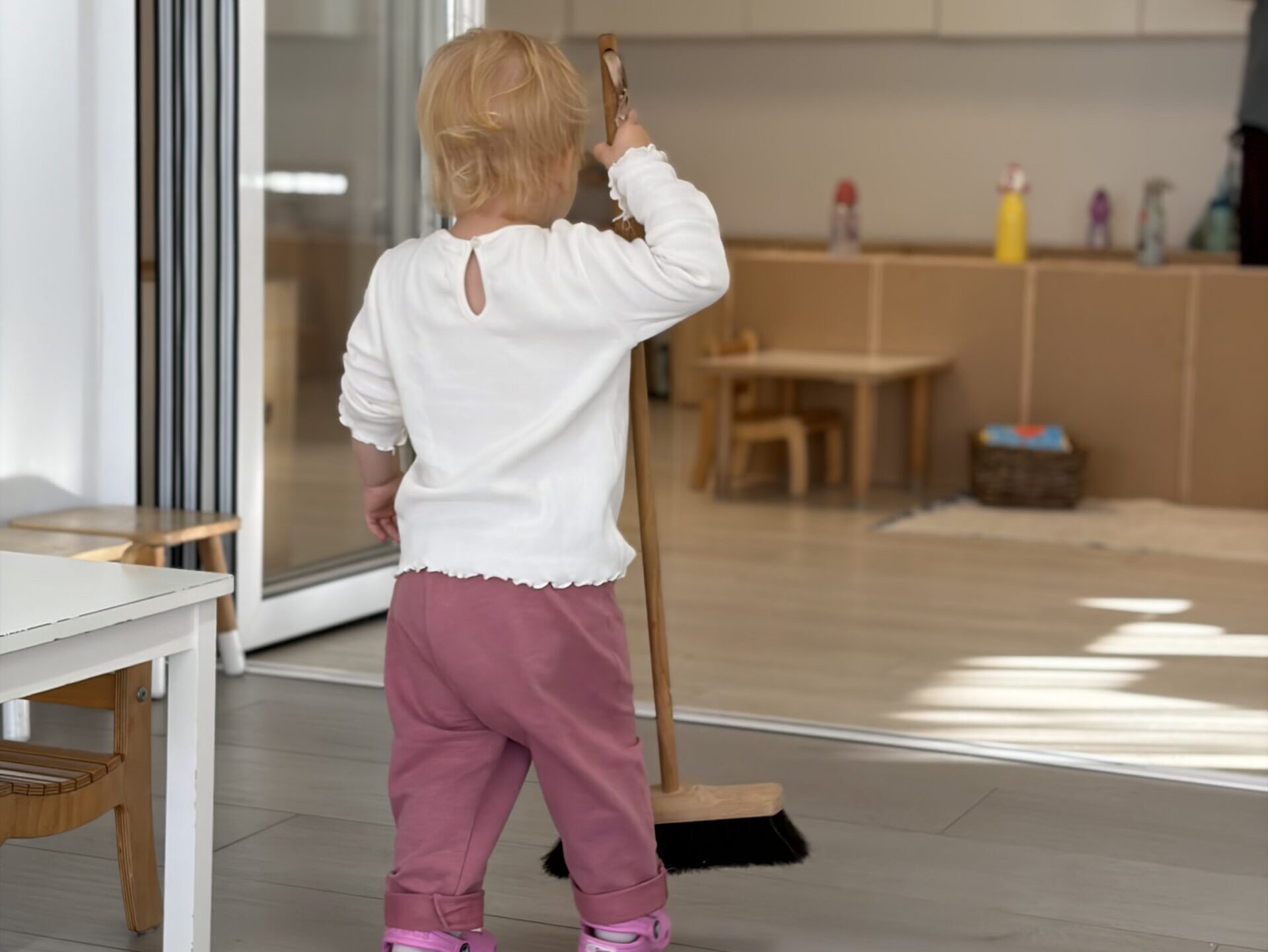
In our Nido and Infant Community, care routines are never rushed. Children wash their hands at a low sink, set the table, pour their own water, serve themselves, and help clean up. They practice dressing for outdoor time and are supported gently through toileting when they show readiness. We work closely with families so that home and school follow a consistent approach.