Why toddlers aren’t “defiant,” and what actually helps
Every parent knows the moment. A child who was cooperative a few months ago now says “no” to everything, throws themselves on the floor, and insists on the one thing they can’t have.
Our culture calls this the “terrible twos.” Montessori saw it as something else entirely: a child in the middle of building one of the most important human capacities, the will.
The will is built, not broken
For generations, parenting advice spoke of “breaking the child’s will.” Montessori rejected this completely. For her, the will is not something to break but something to develop. It is the child’s growing ability to focus attention, hold back an impulse, and choose to act.
Children are not born with a developed will, just as they are not born walking or talking. Modern neuroscience agrees. The skills involved (impulse control, working memory, flexible attention) are known as executive functions. They depend on the prefrontal cortex, one of the slowest regions of the brain to mature. It keeps developing well into the twenties.
This changes how we see a toddler’s behavior. A two-year-old who grabs the forbidden object isn’t choosing to defy us. In most cases, their brain can’t yet hold back the impulse on its own. Our role is to lend them our self-control while theirs grows.
What helps at each stage
In Montessori from the Start, Paula Polk Lillard and Lynn Lillard Jessen describe how our response to limits should change as the child’s brain develops.
Birth to around 9 months: offer something else
Young babies are drawn to whatever they can explore with their senses. When a baby reaches for something unsafe, the simplest approach works: calmly move the object away and offer another. The baby’s attention follows.
What matters most at this stage is the foundation for the will: concentration. A baby left undisturbed to watch a mobile, study their hands, or work at reaching a toy is already practicing sustained attention.
Around 9 to 18 months: move the object or the child
Once babies can hold an object in mind even when it is out of sight, a quick swap no longer works. Now we remove the object from view, or calmly move the child.
A small but meaningful detail from the book: when a crawling or walking child heads toward something unsafe, go around and meet them face to face rather than scooping them up from behind. It treats the child as a person being guided, not an object being relocated.
Around 18 months to 3 years: redirect with language
Now language becomes our main tool. Two strategies work especially well:
- A choice of two. “Would you like to walk to the car or hop like a rabbit?” “The blue cup or the green one?” A simple choice moves the child’s thinking away from “no” and toward a decision they can own. Two options, not more.
- Description. “Look, the fish is swimming to the top. I think he’s hungry. Shall we feed him?” Describing something real and interesting draws the child into the present moment.
What doesn’t work in the moment: long explanations. Children this age benefit from short, simple reasons (“The stove is hot. It can hurt you.”) because these build understanding over time. But lengthy reasoning in the middle of a struggle usually keeps the child’s attention fixed on the thing they want.
Three stages of cooperation
Montessori described obedience developing in three stages. Today we might prefer the word cooperation.
- Around 12 to 18 months: the child understands the request but can’t carry it out without help.
- Around 18 months to 3 years: the child can sometimes follow through alone, and sometimes not.
- Around 3 years: the child can cooperate consistently, and is now also able to choose not to.
Knowing this helps us keep expectations realistic. A two-year-old who follows a request on Tuesday and not on Wednesday isn’t testing us. They are exactly where their development places them.
What the adult brings
- Calm confidence. Children feel secure when the adult is clearly in charge, kind but certain. There is no need to wait until we are angry to act. If redirection doesn’t work, we can calmly follow through: pick the child up, put the object away, leave the store. Warmth and firmness together.
- Consistency. “No” needs to mean no every time. When a limit sometimes gives way to enough crying, children learn to keep pushing. This is not harshness. Predictable limits are one of the greatest sources of security we can give.
- Routine. Under three, children understand the world through repetition far more than through words. A predictable day (the same order to meals, naps, bath and bedtime) answers many questions before they become conflicts.
- Acknowledging feelings. This is where current research adds most to the original book. Naming a child’s emotion (“You’re so disappointed. You really wanted to stay.”) while holding the limit helps children learn to recognize and regulate their feelings over time. Accepting the feeling does not mean changing the decision.
- No physical punishment, no shaming. The AAP advises against physical punishment and harsh verbal discipline. Both are linked to worse behavioral and emotional outcomes. Our goal is a child who develops their own self-control, not a child who behaves out of fear.
The bigger picture
Research on parenting styles (beginning with Diana Baumrind, whom Lillard and Jessen also cite) consistently points in the same direction. Children do best with adults who combine high warmth with clear, reasonable expectations. Too much control without warmth, or warmth without limits, both make the child’s path harder.
Montessori called this freedom within limits. Its purpose is not a compliant child. It is a child who, over time, becomes able to focus, persist, hold back an impulse, and choose well. These are the capacities they will need for everything that comes next.
At Casa del Mar Montessori
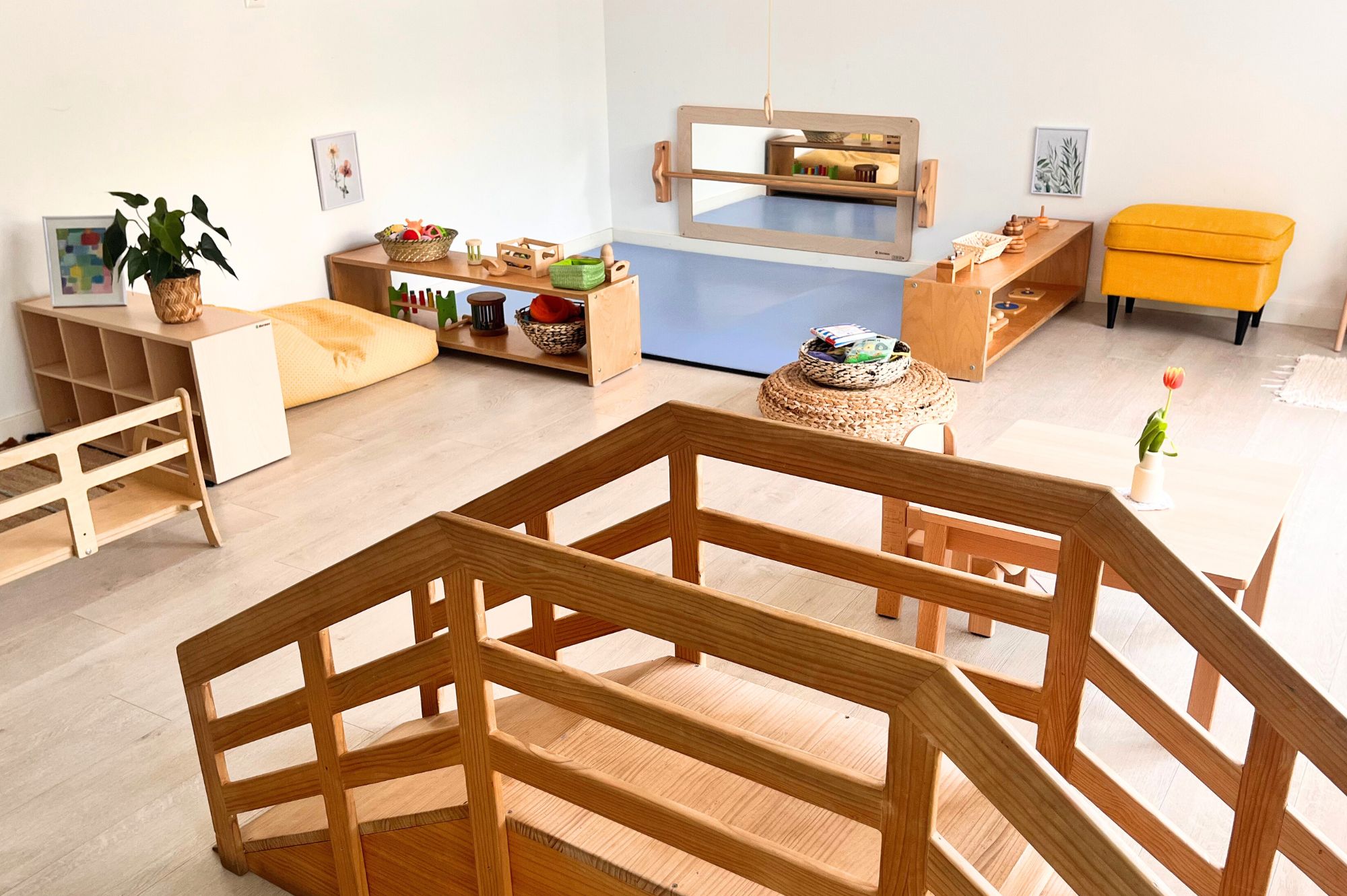
In our Infant Community, limits are few, clear, and always the same. Guides use calm language, offer simple choices, and redirect children toward purposeful activity. When a child is struggling, we stay close and help them through it. We also work with families to bring the same consistency home.